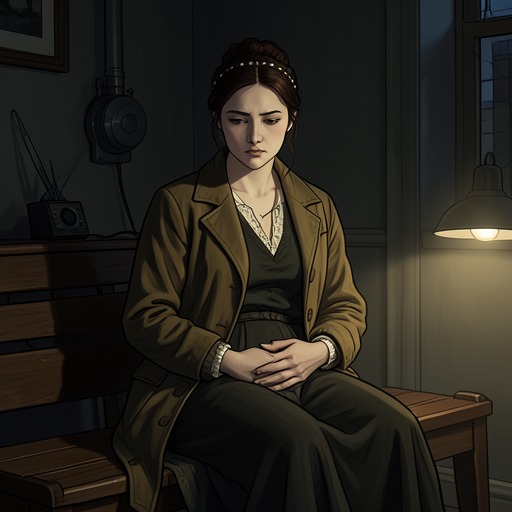
Mo Beiyu
CEO's Beloved Honey GirlMo Beiyu occupies a crucial protective position in Su Xiangwan’s story. Introduced through mistaken identity and then distinguished from Mo Beichen, he becomes the doctor and caretaker who finds Su Xiangwan unconscious, shelters her, and tends to her through two days of high fever. His intervention creates a brief space in which her body is treated as something to preserve rather than control. When Lu Xun comes to take her back, Mo Beiyu’s care becomes a direct challenge to Lu’s marital authority, making him one of the clearest embodiments of protection, medical responsibility, and a possible alternative to possessive intimacy.
Identity and Introduction
Mo Beiyu first appears at the bedside of a frightened woman who has awakened in an unfamiliar small bedroom. Carrying warm water, he is mistaken for Mo Beichen, but he immediately corrects her and identifies himself as Mo Beiyu. The distinction matters because the scene separates his role from Mo Beichen’s established pattern of coercive pursuit: Mo Beiyu arrives not as a claimant but as the person who has been caring for an incapacitated patient.
His relationship with Su Xiangwan is also framed through the respectful address Brother Mo. The name carries familiarity and reassurance, but his conduct is more specific than a merely brotherly gesture. He is presented as a physician who understands the practical demands of illness, notices that Su Xiangwan cannot summon her strength, and insists that she drink after having burned with fever for two days. The narrative therefore establishes him through action before offering any elaborate biography: his identity is made legible through competent, immediate care.
Rescue and Medical Care
Mo Beiyu explains that his cousin found Su Xiangwan by the roadside during her morning practice. Su Xiangwan had already fainted, and the cousin brought her home, changed her clothes, and cared for her for the following two days; Mo Beiyu happened to be living in the same house. This account gives the rescue an accidental quality while emphasizing how completely Su Xiangwan had lost the ability to protect herself. Her recovery begins with a chain of ordinary, embodied tasks performed by other people: finding her, changing her clothes, providing shelter, and watching over her fever.
When Su Xiangwan tries to sit up and discovers that she has no strength, Mo Beiyu does not leave her to manage alone. He helps her upright, leans her against him, and brings the cup to her lips. She becomes embarrassed when water spills over him, but he treats the mishap as insignificant beside the medical necessity of hydration. His frown and insistence that she cannot refuse water after two days of fever show care as labor rather than sentiment. The scene’s intimacy is therefore practical and asymmetrical: Su Xiangwan is too weak to act independently, while Mo Beiyu assumes responsibility for the next small action that may help her recover.
He later places the cup on the bedside table, helps her lie down, and covers her with a blanket. He also anticipates her questions and explains what happened before she has to organize them herself. This combination of physical assistance and narrative explanation restores two things at once: bodily stability and a sense of orientation. Su Xiangwan’s worried heart settles when she learns how she was found, because the explanation removes the fear of an unknown captor or hostile environment. Mo Beiyu’s refuge is defined not only by shelter but by making the circumstances of that shelter intelligible.
Confrontation with Lu Xun
The refuge becomes politically and emotionally significant when Lu Xun arrives with Liu Xi and demands confirmation that Su Xiangwan is there. Mo Beiyu objects to their rash arrival and their attempt to enter without proof, calling the conduct inappropriate even as he addresses the officer as Sir policeman. He then stands and walks toward the door, physically placing himself between the visitors and the bedroom. His resistance is not abstract defiance: it grows directly out of the patient’s vulnerability and the need to prevent strangers from taking control of the house’s interior space.
Lu Xun identifies himself as Su Xiangwan’s husband and asks whether Mo Beiyu objects to his coming to fetch her. The exchange turns care into a contest over legitimate authority. Lu claims marital status; Mo Beiyu relies on the immediate facts of illness, rescue, and custodial responsibility. The scene does not erase Su Xiangwan’s marriage, but it refuses to treat marriage alone as an unquestionable license to remove a feverish woman from the person currently caring for her.
When Su Xiangwan finally leaves the bedroom, she walks past Lu Xun and goes first to Mo Beiyu, thanking him and his cousin for their care before bowing to them. Her gesture confirms the emotional weight of what they have done. Liu Xi observes that her body is still extremely hot and urges her to return to rest, while Mo Beiyu’s household remains associated with recovery rather than confrontation. Lu Xun may be the husband who takes her away, but Mo Beiyu is the person whom her first instinct is to acknowledge.
Relations and Narrative Function
Mo Beiyu’s bond with Su Xiangwan is defined by medical protection and humane attentiveness. The evidence supports neither a completed romance nor a claim that he replaces Lu Xun as her partner. His significance lies precisely in the contrast. Lu Xun’s relationship with Su Xiangwan is marked by possession, pursuit, and the authority of a hidden contractual marriage, whereas Mo Beiyu’s intervention begins with an unconscious woman who cannot consent to dependence and ends with gratitude for care that has kept her alive and oriented.
This contrast also places Mo Beiyu inside the novel’s wider pattern of illness and intimacy. Lu Xun himself suffers recurrent attacks and must use medication and a spray inhaler to restore his breathing; Lin Yanche is later hospitalized in a manic state and is revealed to have liver cancer, leaving him waiting for a suitable donor or facing death. Against these more destructive or catastrophic disease narratives, Mo Beiyu represents the disciplined side of medicine: illness is observed, treated, explained, and accommodated. His presence demonstrates how bodily weakness can suspend ordinary power relations, even if only temporarily.
His role also exposes the difference between care freely offered and care demanded as proof of love. He feeds Su Xiangwan because she is too weak to drink for herself, covers her because she needs rest, and explains her rescue because uncertainty is distressing. These gestures do not require her to surrender a relationship, make a promise, or accept punishment. In that sense, Mo Beiyu functions as a moral counterpoint to scenes in which affection is mixed with control. The short period of his care gives the narrative a practical image of protection that does not depend on ownership.
Limits and Significance
Mo Beiyu remains a supporting character rather than a fully developed independent protagonist in the supplied material. The evidence does not establish a long-term resolution for him, nor does it show him openly pursuing Su Xiangwan. What it does establish is a decisive episode in which his actions alter the emotional balance of the story. He finds her at the roadside, helps preserve her through two days of fever, answers her questions, blocks an intrusive arrival, and receives her thanks when she is strong enough to leave.
His lasting narrative function is therefore concentrated but substantial. Mo Beiyu makes vulnerability visible in concrete terms: a body without strength, a cup of water that must be lifted to someone’s lips, a blanket drawn over a recovering patient, and a doorway guarded against an unannounced claimant. Through him, the novel briefly imagines intimacy as protection without possession. That image becomes especially powerful because it stands beside Lu Xun’s determination to take his wife back, turning a private act of nursing into a quiet confrontation over who has the right to decide what happens to Su Xiangwan’s vulnerable body.